


Software-defined vehicles automotive industry are no longer science fiction. They're here. And they're fundamentally rewriting how cars work, how they're sold, and what you can actually expect from a vehicle you buy today versus three years from now.
Here's the truth: the software-defined vehicle market is projected to grow from USD 447.55 billion in 2026 to USD 1,707.36 billion by 2035 at a CAGR of 16.0%. But that number doesn't capture what's really happening. This isn't just a market expanding. It's an entire industry flipping on its head.
For over a century, cars were hardware. Bolts. Metal. Pistons. Mechanics. Then software started creeping in—first as an afterthought, a control unit here and there. Now? Many vehicles nowadays are software-defined vehicles (SDVs), meaning that their core features and functionalities are primarily driven by software, rather than the mechanical and hardware components, to operate. That shift changes everything.
And I mean everything.
What Software-Defined Vehicles Actually are (And Why You Should Care)
Let me be clear about what "software-defined" really means. It doesn't just mean your car has software. Your 2015 car had software. It had an infotainment system, engine management, all of it.
Software-defined is different. It's an architecture where the software doesn't just manage discrete systems—it orchestrates them. The automotive industry is undergoing a fundamental shift from hardware-centric vehicles to software-defined platforms that can continuously evolve throughout their lifecycle.
That distinction matters. Here's why:
- The car you buy today might not be the car you own in two years. The car you buy is not exactly the car you'll own in three years — the software will have evolved, some features may have been added, some may have changed behavior, and a few may have been removed outright.
- Features don't require a dealership visit. They download wirelessly.
- Updates can change how the vehicle performs at a fundamental level.
Take Tesla. This isn't a knock on traditional manufacturers—it's just the clearest example. On July 21, 2026, Tesla began rolling out its 2026 Summer Update — a major over-the-air software release that transforms the electric vehicle maker's infotainment, navigation, and AI assistant into something far more personal than anything the company has delivered before, with approximately ten new features packed into what is expected to be software version 2026.26, this update marks a pivotal moment in Tesla's software-defined vehicle strategy.
When that update rolled out, every compatible Tesla on the road got better overnight. A Model 3 from 2018. A Cybertruck from 2026. All the same. No dealership. No waiting.
That's not a feature. That's a business model being reborn.
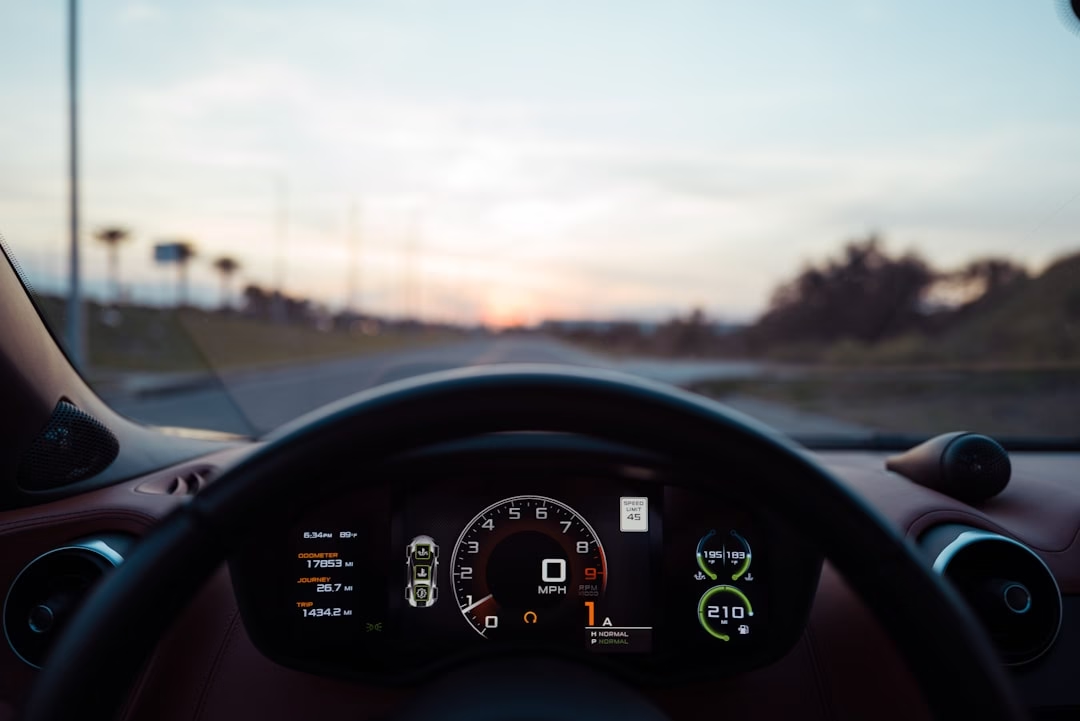
How Software-Defined Vehicles are Flipping the Economics of the Automotive Industry
Here's where it gets interesting (and slightly terrifying, if you're a traditional automaker).
For 120 years, the car business worked like this: sell a car, collect money, watch it depreciate for the next ten years. The value proposition was locked in at the factory gate. After you drove it off the lot, your car only got worse (unless you paid a dealer to fix things).
Software-defined vehicles flip that. Consumers increasingly expect vehicles to receive new features, performance improvements, and security enhancements through over-the-air (OTA) updates, while automakers seek new recurring revenue opportunities through subscription-based services and feature-on-demand models.
Market trends highlight a significant shift towards cloud computing, over-the-air (OTA) updates, and advanced analytics to deliver continuous software enhancements and personalized user experiences, with automakers prioritizing software-defined architectures to enable flexibility, scalability, and faster deployment of new features.
The revenue model is shifting, too. Subscription features. Feature-on-demand. Pay-as-you-go upgrades. Not all at once—we're not there yet—but the direction is unmistakable.
I once watched a traditional automotive engineer (who had been in the industry for 32 years) try to explain to me why his company couldn't push updates to vehicles without a service appointment. The answer came down to the architecture. The hardware. It wasn't built for this. And retrofitting 50 million vehicles on the road? That's not happening. That's why some manufacturers are starting from scratch with new platforms.
Software-Defined Vehicles Automotive Industry Adoption: Where We are in 2026
Let's talk about who's actually doing this, not just talking about it.
Most survey respondents are currently working on SDV architectures (57%), while as many as 81% consider electric vehicle architecture as part of the organization's broader SDV strategy. So over half the industry is actively building this. That matters.
But here's the catch: The Semi SDV segment holds the largest share of 60.3% in 2026 within the software defined vehicle market largely because this segment offers a pragmatic balance between cutting-edge technology and existing automotive infrastructure. North America, holding a share of 31.2% in 2026, is projected to be the fastest growing region.
Translation? Most manufacturers aren't going fully software-defined. They're going semi-software-defined. Blending old architecture with new capabilities. It's a safer bet, but it also explains why only Tesla has pulled off true OTA at scale.
The real play right now is in electric vehicles. Rising consumer preference for electric and autonomous vehicles further accelerates the adoption of software-centric solutions, positioning the software defined vehicle market as a critical segment in the future of automotive technology. EVs are built from the ground up with software-first thinking. ICE vehicles? That's a retrofit nightmare.
The Real Cost: Software-Defined Vehicles and the Complexity Nobody Talks About
Okay, so software-defined sounds amazing. Infinite updates. Your car gets better forever. No dealership visits.
There's a cost. And I'm not just talking about money.
The scope of what an over-the-air update can modify on a modern vehicle is broader than most owners realize. Essentially everything software-controlled on a current-generation car is potentially changeable through an OTA update.
That means battery performance. Braking behavior. Acceleration curves. Charging speed. ADAS sensitivity. All of it.
That includes battery and powertrain software — charging curves, regen braking calibration, power output limits at different battery states of charge, thermal management thresholds. A Tesla that charged to 90% at 150 kW in January might charge to 90% at 130 kW in April with the same battery and the same charger, because the software decided to extend pack life by reducing peak rates.
Your car is a living system now. That's elegant from a software perspective. From an owner's perspective? You need to think differently about updates. You can't just install every release on day one. Some people wait 24-48 hours. Check forums. See if early adopters hit any issues.
It's a different relationship with the product. Honestly? It's still jarring for people who bought cars in 2015.
Over-The-Air Updates and the New Reality of Vehicle Ownership
Let's dig into what OTA actually means now in 2026.
Tesla shipped more than 20 distinct software versions to its fleet in the first four months of 2026. Some carried minor fixes. Others rewrote the entire AI compiler from the ground up. That pace is insane by automotive standards. It's normal by software standards.
Many recalls and safety fixes are now handled via software instead of physical repairs. New features can show up years after you bought the car, effectively making it "feel newer."
Here's a practical example. You buy a 2024 Model 3. In 2026, Tesla rolls out an AI assistant that can control climate, music, and glovebox access. Your car, which was already three years old, now has this new feature. For free. No hardware upgrade required—the hardware was already capable; the software just wasn't unlocked yet.
Compare that to a traditional sedan. You want a better air conditioning system? You're stuck. That hardware is what it is.
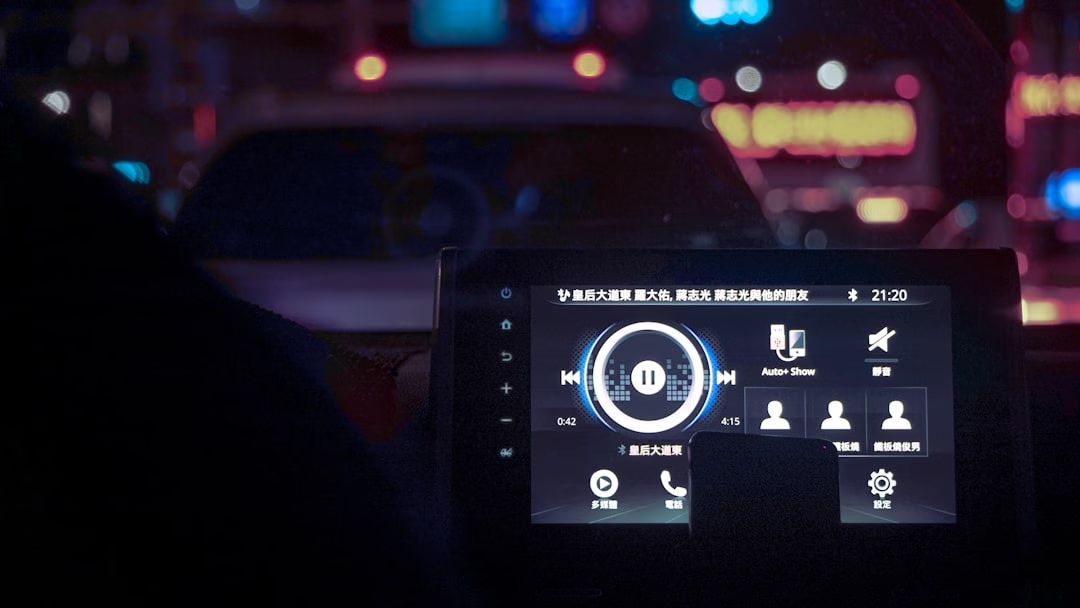
Challenges the Software-Defined Vehicles Automotive Industry is Still Struggling with
Let's not pretend this is all seamless. Because it's not.
The biggest issue? Cybersecurity. Increasing integration of cloud-based vehicle services is happening right now, and with it comes exposure. A car that can be updated remotely can also be attacked remotely. That's not theoretical. It's happening. Manufacturers are deploying over-the-air patches to close security holes that exist in cars already on the road.
Second issue: Standardization. Right now, every manufacturer has its own software stack. Tesla's. GM's. Volkswagen's. VinFast's. No interoperability. No standards. Breakdown of SDV levels and key enablers such as high-performance compute (HPC), zonal control, and OTA updates — these exist, but adoption is fragmented.
Third: Legacy hardware. If you own a car built before 2020, odds are high it cannot receive true software-defined updates. The hardware wasn't designed for it. So we're living in a split market: new cars that evolve, old cars that don't.
Frequently Asked Questions
What Exactly is the Difference Between a Software-Defined Vehicle and a Regular Car with Software?
A software-defined vehicle has an architecture where software controls core functionality. A regular car has software that manages specific components (engine, brakes, infotainment) independently. Software-defined vehicles orchestrate these systems as an integrated whole, allowing manufacturers to update and improve functionality wirelessly without hardware changes.
Are All Software-Defined Vehicles Automotive Industry Vehicles Electric?
No. Software-defined architecture can be applied to gas and electric vehicles. However, electric vehicles are adopting software-defined platforms faster because they're being designed from the ground up with software-first thinking, while traditional combustion engines require retrofitting.
How Often will My Car Receive Software-Defined Vehicles Automotive Industry Updates in 2026?
Frequency varies by manufacturer. Tesla releases updates every 3-6 weeks on average. Traditional manufacturers are typically slower, releasing updates quarterly or annually. As the industry matures, expect frequency to increase across most brands.
Can Software-Defined Vehicles Automotive Industry Updates Make My Car Worse?
Technically, yes. Updates can change performance characteristics (charging speed, acceleration, braking response). Manufacturers claim these are optimizations for longevity, efficiency, or safety, but the car you own will not be identical to the car you purchased within 12-24 months of ownership.
Will Software-Defined Vehicles Cost More than Traditional Cars?
Initially, yes. The hardware and infrastructure required for true OTA capability adds cost. However, long-term value may be higher because vehicles can be updated rather than replaced. Some manufacturers are monetizing updates through subscriptions, which could offset initial cost differences.
The Takeaway: Your Next Car will be a Different Product than You Think
Software-defined vehicles automotive industry transformation isn't coming. It's here. The software-defined vehicles market size will grow from $64.92 billion in 2025 to $76.48 billion in 2026 at a compound annual growth rate (CAGR) of 17.8%.
But here's what actually matters: when you buy your next car, understand what you're buying. You're not just buying hardware anymore. You're buying a platform that will change. The vehicle in your driveway in July 2026 will not be the same vehicle in July 2027—not in any meaningful way.
Features will be added. Performance will be tuned. Behaviors will shift. Some updates will be improvements. Some will be forced. Some will trade off one thing for another (battery longevity for charging speed, for example).
That's not bad. It's just different. And you need to know what you're getting into. Read the OTA policy. Check how frequently the manufacturer updates vehicles. Understand that ownership is now a relationship with a living system, not a fixed product.
The old model—buy a car, own it the same way for 15 years—is dead. Welcome to the software-defined future.

