
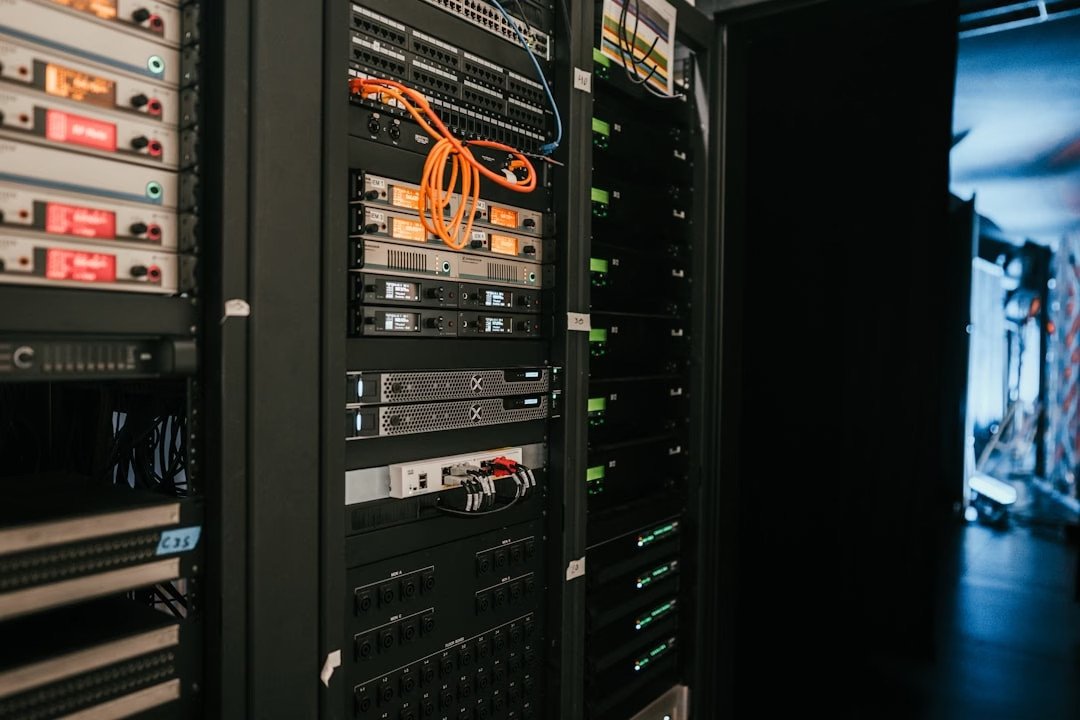

Businesses data infrastructure ever has become the defining investment lever of 2026. Not for startups. Not for curiosity's sake. For survival. 74% of IT leaders expect their budgets to increase in 2026, and they're not hesitating on data infrastructure. The machine that runs AI now runs everything — and it costs more than most companies spend on their entire payroll.
This is the real story: it's not hype. It's not over. It's just getting going.
Why Businesses Data Infrastructure Ever Exploded in Scale
You walked into this era without your company realizing the bill was already coming. Data arrived quietly. Then AI woke everyone up at once.
Companies worldwide are expected to invest nearly $7 trillion in building and upgrading data centers between now and 2030. To put that number somewhere your brain can hold it: that's roughly the GDP of the entire UK, spent just on the physical pipes to move data. Not once. Year after year for five years.
Here's what changed. Six months ago, a data center was infrastructure — boring, necessary, hidden. Now? Alphabet, Amazon, Microsoft, and Meta plan to invest over $350 billion in data centers in 2025 and about $400 billion in 2026. That's not gradual. That's urgent. That's "we might fall behind the competition" urgent.

I remember sitting in a 2024 board meeting where a CFO questioned whether cloud costs were out of control. Today that question sounds quaint. Amazon, Alphabet, Microsoft, Meta, and Oracle are collectively forecast to exceed $600 billion in capital expenditure in 2026 — a 36% increase over 2025, with roughly $450 billion of that spend directly tied to AI infrastructure. That's not cautious spending. That's a land grab.
Why AI Specifically Drove Businesses Data Infrastructure Ever into Overdrive
The numbers get strange when you zoom in on AI infrastructure alone. In 2024, AI data center investments soared to $57 billion, with growth at an extraordinary 28.3% rate, outpacing traditional data center growth of 11.24%. AI is growing faster than the thing it's built on top of.
The average cost of an AI rack is projected to hit $3.9 million in 2026, compared to just $500,000 for traditional server racks, representing almost an 8x increase in infrastructure investment for every unit of compute capacity. You read that right. Eight times more expensive for the same amount of raw processing power, because AI workloads demand precision cooling, redundancy systems, and power delivery at scales that break older thinking.
The catch? The economics are inverted. The focus moved from model training toward inference — where trained AI models analyze new data to make predictions — with Deloitte estimating inference made up half of all AI compute in 2025, growing to two-thirds in 2026, and Brookfield projecting 75% by 2030. Training is a one-time cost. Inference is a forever subscription to compute. That's why the investment keeps climbing.
The Cloud Market Crossover: Businesses Data Infrastructure Ever Hit Mainstream
Public cloud spending is forecast at $850 billion in 2026, a 21.3% jump from 2025. Let that settle. That's one vendor category. Not total IT spending. Not all enterprise infrastructure. Just public cloud. Global spending on public cloud services is forecast to surpass $1 trillion in 2026—growing over 21% when you add managed services and private offerings.
What's wild: most companies weren't ready for this shift. Modernization of legacy systems is the top challenge for 2026, with 46% of IT leaders selecting it as their primary concern, indicating a shift from last year's focus on tool sprawl and adoption patterns, with modernization now viewed as a prerequisite for supporting current demands and future growth.
You've got old systems anchoring critical workflows. You've got new AI systems demanding infrastructure that didn't exist three years ago. And you're paying for both simultaneously (yes, really). That's why the investment bucket keeps getting deeper.
Where Businesses Data Infrastructure Ever is Actually Being Built
Geography matters now. The United States leads with 5,426 data centers, housing 51% of the world's hyperscale AI facilities, and 60% of new data centers in 2026 will be built in the U.S., thanks to favorable regulations, abundant land, and easy access to power infrastructure.
But the real constraint isn't land. Power constraints, not capital limitations, create the main bottleneck for building data centers. You can pour money into buildings. You can't pour money into electricity that doesn't exist. Virginia's grid is hitting limits. Rural Iowa, rural Michigan — they're becoming the new cloud capitals because they have reliable power and room to build.
This creates a weird tension. Companies now face a tough choice: they risk stranded assets by overinvesting or falling behind competitors by underinvesting. Build too much data center capacity and it sits empty. Build too little and your competitors train better models, serve customers faster, own the market.
Construction Costs are Rising, and Nobody's Happy About it
Reality check: this expansion is getting expensive. Industry experts predict the average global cost will reach USD 11.30 million per MW in 2026, a 6% increase, with most industry professionals (60%) expecting construction costs to rise by 5-15% in 2026.
That's before you factor in the specialized cooling systems, the GPU clusters, the redundancy infrastructure. AI-optimized data centers need advanced cooling systems, higher power densities, and cutting-edge hardware, including GPUs, TPUs, and other AI accelerators. These aren't standard server rooms anymore.
The economics shift again when you realize annual investment in data centre buildings will more than double over three years, reaching US$252 billion in 2027. That's the building itself. Add the hardware, the power infrastructure, the interconnects between facilities, and you're looking at costs that only massive companies can absorb.
The Takeaway: Businesses Data Infrastructure Ever Became Non-Negotiable
Here's what matters: 74% of IT leaders expect their budgets to increase in 2026, but greater funding does not necessarily translate into expanded internal capacity, with more than half of respondents reporting they still lack the internal resources needed to address issues promptly. You're spending more money. You're still stretched thin. That's the paradox of 2026.
Businesses data infrastructure ever went from a cost line item to a competitive weapon. If you're not investing, you're falling behind. But the investment decisions you make now — where to build, what to upgrade, how to modernize legacy systems alongside AI infrastructure — will define whether your company leads or follows for the next five years. There's no waiting. There's no "we'll figure it out later." The infrastructure bill is due now, and it's larger than anyone expected.
Frequently Asked Questions
Why are Businesses Data Infrastructure Ever Investments Accelerating So Fast?
Growth is driven by enterprise-wide application modernization, accelerating adoption of AI-enabled platforms, and rising demand for secure, scalable digital infrastructure across industries. AI workloads require hardware that didn't exist two years ago, forcing companies to rebuild infrastructure faster than planned.
What Percentage of it Budgets Go to Businesses Data Infrastructure Ever?
Public cloud now accounts for 45% of enterprise IT spending, up from 17% in 2021. When you include on-premises data center upgrades, the share climbs even higher. For many large enterprises, it's now the single largest IT category.
Why is the Average Cost Per Businesses Data Infrastructure Ever AI Rack Eight Times Higher than Traditional Racks?
AI workloads generate extreme heat and require precision power delivery, specialized cooling (liquid cooling vs. air cooling), and redundancy systems that traditional hardware doesn't need. 73% of new AI data centers are now installing direct-to-chip or immersion cooling systems, rendering older air cooling methods obsolete. That specialization costs money.
When will Global Spending on Businesses Data Infrastructure Ever Hit $1 Trillion Per Year?
Based on current growth rates, global cloud and data center spending combined should cross $1 trillion annually sometime in 2027 or 2028. The global cloud computing market is valued at $917.9 billion in 2026 and is expected to cross $1 trillion before the end of the year when including all deployment models.
How Long do Companies Have to Make Businesses Data Infrastructure Ever Decisions Before They're Locked Out?
Most CFOs aren't asking this yet, but they should be. CEOs hesitate to invest fully because they cannot clearly see future AI adoption patterns and face long infrastructure project timelines. Infrastructure takes 18-36 months to become revenue-generating. If you start building in late 2026, you're serving demand in 2028. By then, faster movers have already captured market share. The window for intelligent investment is closing.

