


You've probably noticed the shift. Cars aren't just getting safer or faster anymore—they're becoming little retail destinations. In-car digital commerce new is happening right now, with the market set to reach USD 6.4 billion by 2026-end, and honestly, most drivers have no idea how big this is about to get.
The thing is, in-car digital commerce new represents something larger than just swiping a payment on your steering wheel. It's the collision of two unstoppable forces: connected vehicles that know where you are and what you need, and a generation of consumers who've stopped carrying wallets. You're already shopping in your car—for parking, gas, tolls, maybe a coffee. Now the industry is building the infrastructure to turn that habit into a genuine commerce ecosystem.
This matters because the opportunity here is massive, fragmented, and wide open. For automotive manufacturers, tech companies, and fintech players, in-car digital commerce new is territory that's being claimed right now, in 2026. The winners won't be whoever moves slowest.
In-Car Digital Commerce New is Growing Faster than You'd Expect
Let's get the numbers out of the way. The market is expected to grow from USD 2.04 billion in 2026 to USD 17.3 billion in 2035, at a CAGR of 26.9%—that's genuinely fast. Some analysts are even more bullish. Compare that to traditional retail growth rates, and you're looking at something that's accelerating.
Why so fast? Three reasons. First, EVs need charging infrastructure, and that charging needs payment systems. Second, connected vehicles (the ones that actually talk to the internet) are becoming the default, not the exception. Third, and this is the part nobody talks about: drivers want convenience more than they want almost anything else.
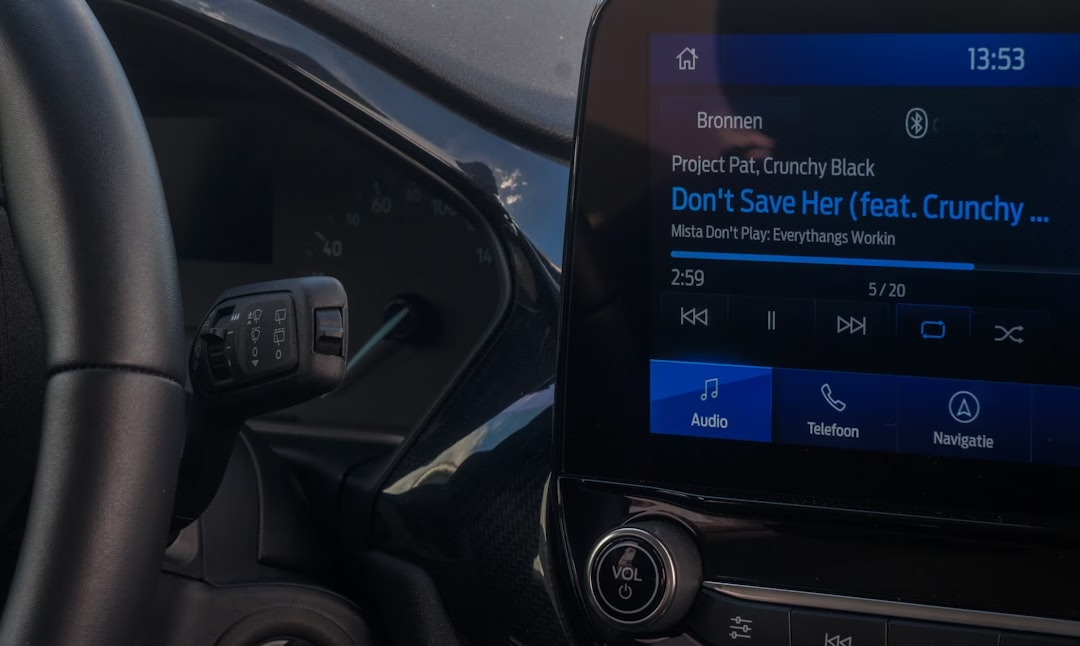
The market has multiple segments, and they're not all equal:
- Parking and tolls — Already normalized, integrated into city infrastructure
- Fuel and charging — Growing as EV adoption accelerates (a genuine driver of in-car commerce)
- Food and beverages — Still emerging, but the infrastructure exists
- Retail and miscellaneous services — The frontier nobody's cracked yet
- Digital wallets and mobile payments — The backbone of everything
By mode of payment, the debit card and credit card segment hit market share of over 54% in 2025, which tells you something important: drivers trust what they already know. The revolution isn't about new payment methods—it's about old ones working seamlessly inside the car.
In-Car Digital Commerce New Solves a Real Friction Problem
Here's a moment I won't forget. I was sitting in my parked car at a meter in San Francisco in early 2024, fumbling with my phone to pay for parking, and I thought: this is insane. The car has GPS. It knows I'm here. Why am I doing this manually?
That's the problem in-car digital commerce new actually addresses. You don't need more payment methods. You need payment that doesn't require thinking.
Passenger vehicles are witnessing increased integration of embedded in-vehicle payment features within infotainment systems, enabling seamless payments for fuel, parking, tolls, and digital services without reliance on external devices. This isn't flashy. It's unglamorous. But it's the entire reason this market exists.
The OEMs get it. Honda Motor led with over 16.9% market share in 2025, and the company isn't winning because Hondas are cooler—they're winning because Honda vehicles talk to Honda's payment infrastructure without friction.
But here's the catch: most of this growth is happening in infrastructure that consumers don't see. Tolls, parking, fuel—these are regulatory-mandated or infrastructure-mandated integrations. The real money in in-car digital commerce new comes when you convince drivers to buy other stuff from inside the car. Coffee. Snacks. OTA software updates. Subscriptions.
That's still mostly theoretical in 2026.
The Ev Charging Goldmine That's Driving this Whole Thing
Electric vehicles changed the equation entirely. When you pull into a gas station, you spend three minutes. When you charge an EV, you spend 20 to 45 minutes (depending on the charger). That's a captive audience with time on their hands.
Increase in EV adoption and charging infrastructure is explicitly called out as a primary growth driver, and that's not accidental. Every EV sold creates a new payment moment that didn't exist before. A Tesla owner in 2026 can pull up to a Supercharger, plug in, and the payment happens. No app. No walking inside to swipe a card. The vehicle owns that transaction.
Simultaneously, the Supercharger network becomes a retail location. What do you do while you charge? Ideally, you're eating, browsing, shopping—and the vehicle is your point of sale.
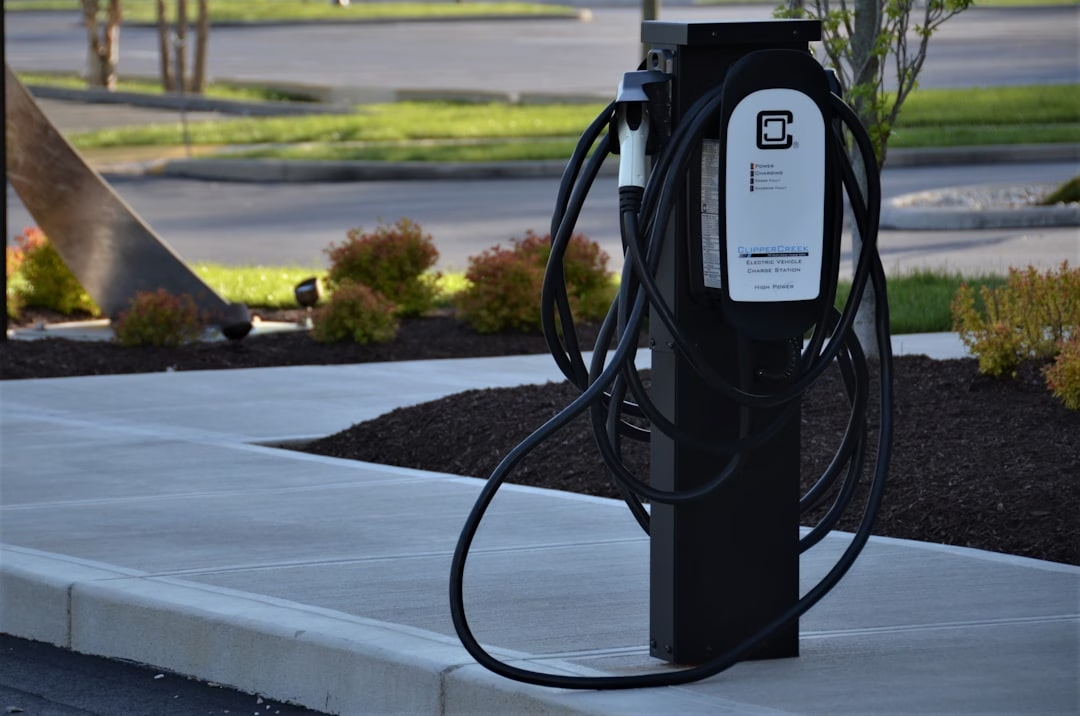
This is the most developed piece of in-car digital commerce new in 2026, and it's also why the market projections are so confident. The infrastructure has to be there. The payments have to work. There's no friction-free alternative.
Who's Actually Building this Infrastructure
The players are a mix of old and new. Leading Players in this market include Honda Motor, Ford Motor Company, Hyundai Motor, BMW, ZF. You've got automakers, which makes sense. You've got tier-one suppliers like ZF, which also makes sense. And then you've got the fintech players working in the background, building the plumbing.
What's interesting is that in-car digital commerce new doesn't have a clear winner yet. It's fragmented. Some manufacturers are building proprietary systems. Some are partnering with fintech. Some are relying on Apple CarPlay and Android Auto integrations (which, honestly, feel like the lazy option, and also the smartest option—why reinvent payment when your customers already trust Apple Pay?).
The real tension is this: Do you want in-car digital commerce new to be standardized and interoperable, or proprietary and lucrative? OEMs want proprietary. Consumers want interoperable. Regulators, increasingly, are forcing interoperability.
In-Car Digital Commerce New's Security and Privacy Problem
This is where in-car digital commerce new gets uncomfortable. You're adding payment processing, biometric authentication (some systems use facial recognition or fingerprints), and location data to your vehicle. That's a treasure trove if something goes wrong.
Cybersecurity and data privacy concerns are explicitly listed as a market challenge, and they should be. I don't know about you, but the idea of my car's payment system getting compromised is more unsettling than my laptop getting hacked. At least my laptop doesn't drive itself to random locations.
The industry is aware. Adoption of biometric and voice-enabled payment authentication is being positioned as a solution, and it helps—your voice or fingerprint is harder to steal than your credit card number. But it's also creepier, which is the tradeoff nobody wants to have.
Regulatory bodies are moving. But regulatory bodies move slowly. In-car digital commerce new is rolling out faster than the rules can keep up.
What Doesn't Exist Yet (But Definitely Should)
The weird thing about in-car digital commerce new in 2026 is that the most obvious use cases are already happening, and the most interesting ones are barely starting.
You can pay for parking and gas and tolls. Fine. Solved. But you can't really:
- Buy things while the car is moving — Not legally, for safety reasons. But while charging? While parked? That's an opening.
- Enable commerce between drivers — Peer-to-peer transactions from one car to another. Imagine paying a stranger to let you cut in line at a Supercharger. (Yes, this is dystopian and probably illegal in most places, but it's theoretically possible.)
- Integrate insurance and maintenance — Your car knows when it needs an oil change. Why can't it book the appointment and pre-pay?
- Build real retail inside the charging ecosystem — Most EV charging stations still feel like rest stops from 1987. The retail is dead. The point-of-sale is clunky.
These are the opportunities where in-car digital commerce new could actually get interesting. They're not happening yet because the infrastructure isn't ready. But they're coming.
Frequently Asked Questions
What Exactly is in-Car Digital Commerce New, and Why does it Matter?
In-car digital commerce new refers to digital payment and shopping systems built directly into vehicles, enabling drivers to pay for fuel, parking, tolls, and other services without leaving the car or using external devices. It matters because it reduces friction, creates new revenue streams for automakers and payment providers, and is growing at 26.9% annually.
How does in-Car Digital Commerce New Work with Electric Vehicles?
Expansion of EV charging payment integration is a primary growth driver. EVs require longer charging times than gas cars require for refueling, creating a captive customer base. In-car digital commerce new enables seamless payment at chargers and opens retail opportunities during those 20-45 minute charging windows.
Is in-Car Digital Commerce New Secure?
Mostly. Payment systems are encrypted, and biometric authentication is increasingly common. The bigger risk is data privacy—your vehicle now knows your location, spending patterns, and payment information. Cybersecurity and data privacy concerns are acknowledged risks, but regulatory frameworks are still catching up.
Which Automakers are Leading in-Car Digital Commerce New?
Honda Motor led with over 16.9% market share in 2025. Ford, Hyundai, BMW, and ZF are also major players. But the market is fragmented—there's no single dominant standard or platform yet.
What's the Difference Between in-Car Digital Commerce New and Regular Mobile Payments?
In-car digital commerce new is integrated and automatic. Your phone can do mobile payments, but your car can do them without you pulling the phone out. When you drive into a parking garage, the car recognizes the location and initiates payment automatically. That's the difference between convenience and frictionless convenience.
The Real Opportunity is Happening Right Now
In-car digital commerce new is one of those rare situations where the infrastructure is being built at exactly the right moment. EVs are rolling out. Connected vehicles are becoming standard. Contactless and digital payments are normalized globally. The pieces fit.
But—and this is crucial—the real value isn't in the transactions that already work. Tolls and parking and fuel will happen whether or not anyone innovates further. The opportunity is in new behaviors. In creating reasons for drivers to spend more time interacting with in-car commerce. In building retail experiences inside vehicles that actually feel valuable, not bolted-on.
If you're in automotive, fintech, or retail, in-car digital commerce new is the lane you should be watching. Not because it's big yet—it's not, relative to the total automotive market. But because it's accelerating, fragmented, and hasn't been won yet. That's the kind of opportunity that doesn't stay open forever.

