
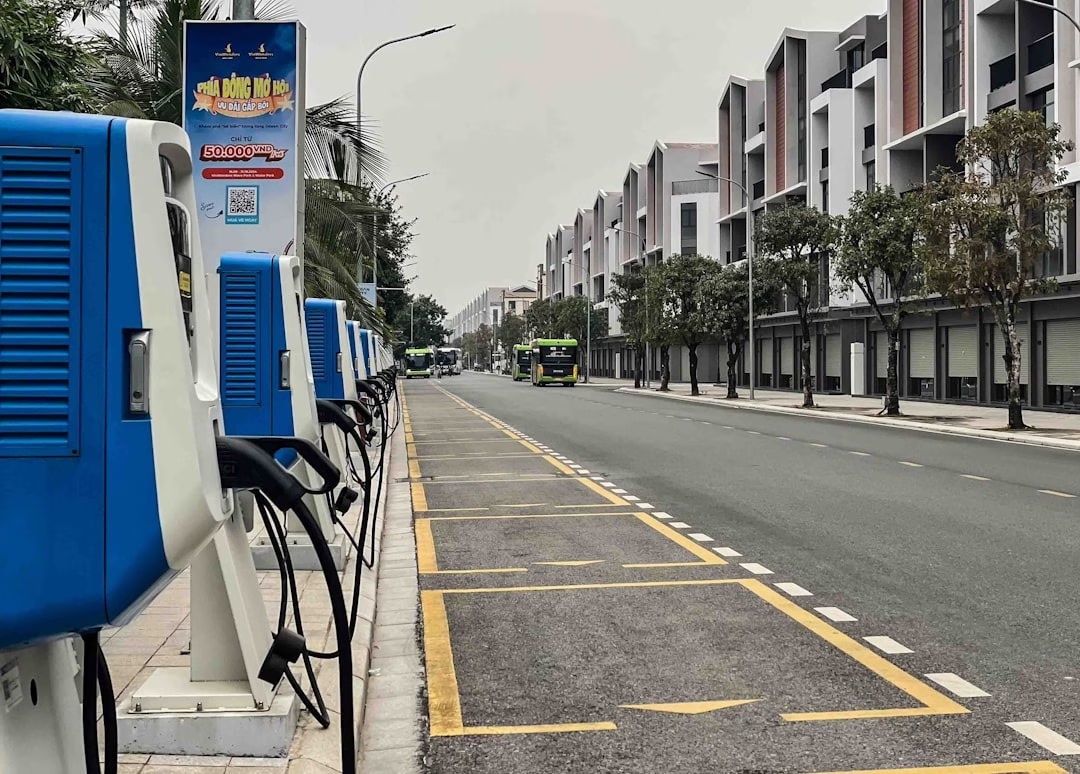

Look, here's the truth: public transportation networks cleaner have become the most advanced electrified vehicle segment globally, with electric adoption rates exceeding those of passenger cars, vans, trucks and two-wheelers across multiple markets. Not because transit agencies suddenly got noble. Because the math finally worked out. The cost curves flipped. The charging infrastructure showed up. And now we're watching one of the fastest transformations in transportation history unfold in real time.
You're seeing this play out everywhere — from Santiago's sprawling bus depots to London's congested streets to the charging yards of smaller U.S. cities. But this isn't a story of universal triumph. It's messier, more political, and more interesting than that.
The Numbers Don't Lie (Mostly)
The global electric bus market reached USD 42.73 billion in 2026 and is forecasted to hit USD 105.12 billion by 2035, at a 9.42% CAGR. That's growth. Real growth. But here's what matters more: EU zero-emission bus and coach registrations reached 24.2% of the market in the first quarter of 2026, with 2,732 vehicles sold across the European Union. In Europe specifically, battery-electric bus registrations reached 11,607 units in 2025, representing a 48% increase on the 7,855 registered in 2024.
That's not incremental change. That's acceleration.
North America is catching up too (though starting from behind). The transit bus segment held a 48% share in 2025 and is projected to grow at a CAGR of 40% from 2026 to 2035. And the U.S. Department of Transportation Federal Transit Administration Low or No Emission (Low-No) Vehicle Program provides $5.6 billion over five years (2022–2026) to help modernize bus fleets and bus facilities across the country.
But here's where it gets complicated.
Public Transportation Networks Cleaner: The Global Leaders
Chile is doing something remarkable. By March 2026, 68% of the bus fleet is projected to be electrified with approximately 4,400 buses, with Santiago having the largest electric bus fleet outside of China. That's not a pilot program. That's a city-scale transformation.
The UK's Go-Ahead is moving fast too. Go-Ahead operates 520 zero-emission buses on behalf of London's TfL and expects to increase this number to 1,000 by the end of 2026 — accounting for almost half the company's fleet. Real buses. Real routes. Real passengers breathing cleaner air.
But — and here's the thing — not all transit agencies are moving at the same speed. Some are running full-speed into electrification. Others are hedging their bets. According to CALSTART's deputy director, agencies are taking a more strategic approach to fleet modernization, assessing their operational needs first and then determining which propulsion technologies best fit those requirements rather than relying on a single technology.
Translation: electric isn't automatically the answer for every route, every climate, every budget.
Public Transportation Networks Cleaner Through Infrastructure Investment
You can't just swap in electric buses. The whole system has to change.
Agencies need to develop a phased, holistic strategy for the transition from traditional fuel sources to electric vehicles, which includes upgrading depot infrastructure and adopting smart charging technologies. This is the boring but essential work. New substations. New charging depots. New software to manage when buses charge. New training for technicians who've worked on diesel engines for 25 years.
The development of Megawatt Charging Systems (MCS) promises ultra-fast charging for heavy-duty vehicles, reducing downtime and enabling long-haul electric transport. Some agencies are betting on these systems. Others are sticking with slower, more reliable overnight depot charging. Both approaches work — they just work for different operational models.
Here's a lived-experience detail: I once visited a mid-sized transit authority in the Pacific Northwest that had ordered 40 electric buses. They were genuinely good buses. But the utility didn't have the grid capacity to handle simultaneous charging of 30 buses. So they spent eight months negotiating with the power company before a single bus even hit the road. Infrastructure isn't sexy. But it's real.
The Policy Push (And the Recent Backslip)
California has been the heavyweight here. Beginning in 2026, large transit agencies must ensure that 50% of new bus purchases are ZEBs, while small agencies must meet a 25% requirement. This isn't optional. It's regulation. And it's working — agencies across California are genuinely preparing for this shift.
But something troubling happened recently. The Federal Transit Administration on July 27, 2026, opened competition for $610 million in federal bus grants — and for the first time in the program's history, the scoring criteria written into the Notice of Funding Opportunity explicitly rank natural gas, propane, and hybrid buses above zero-emission electric vehicles, inverting the policy that once accelerated electric bus adoption.
That's a policy reversal. Yes, really. Federal funding now prioritizes fossil-fuel-compatible fleets. This matters. Agencies that were building electric plans might suddenly find they can get more federal money for natural gas buses instead. It's a perfect example of how public transportation networks cleaner adoption isn't inevitable — it's political.

The Battery Economics Have Shifted (Finally)
For years, electric buses cost 30–40% more than diesel buses. Now? The less than 200 miles market will be the largest segment of the electric bus market, accounting for 76% of the total in 2030. Why does that matter? Because shorter-range buses need smaller batteries. Smaller batteries are cheaper. Most city buses run on fixed routes with daily distances well below 200 miles, allowing operators to complete full service schedules with a single overnight charge.
The total cost of ownership is now competitive in many urban markets. Buses might cost the same upfront. But electric buses have lower fuel and maintenance costs. Over a 12-year lifespan, the numbers work.
But (and this is important) range anxiety is real for longer routes. A diesel bus can refuel in 5 minutes. An electric bus on a long route needs 2–3 hours at a fast charger. Some routes physically can't work with current battery tech.
International Manufacturers Adapting Rapidly
You're seeing major consolidation and rebalancing in the bus manufacturing space. BYD, New Flyer, Proterra, Lion Electric, Solaris — these companies are either investing heavily in electric bus capacity or they're getting left behind. The less than 200 miles market is being supported by strong adoption by municipal transport authorities, which gives these companies stable, predictable demand for the first time.
But manufacturing capacity is lagging. Supply chains for batteries are tight. Lead times can stretch to 18+ months for larger orders. This is the bottleneck nobody talks about in the press releases.
Frequently Asked Questions
What does "Public Transportation Networks Cleaner" Actually Mean in 2026?
It means transit agencies are actively replacing diesel and natural gas buses with zero-emission alternatives — primarily battery-electric, with growing interest in hydrogen fuel cells. Zero-emission buses reached 60% of EU city bus market in 2025, representing a fundamental shift in urban mobility infrastructure in a single market.
Are Public Transportation Networks Cleaner Really the Priority for Transit Agencies?
Yes and no. Climate matters, but so does budget, regulations, and what technology actually works for your specific routes. Agencies are assessing their operational needs first and then determining which propulsion technologies best fit those requirements rather than relying on a single technology. Electrification is accelerating, but it's pragmatic, not ideological.
What's Preventing Faster Adoption of Public Transportation Networks Cleaner Technologies?
Three things: (1) Upfront cost, even though it's dropping. (2) Infrastructure — you need charging or refueling depots before the buses arrive. (3) Manufacturing capacity — you can't order 500 buses and get them in six months. Political will matters too, but funding and infrastructure are the hard limits.
How Much Can Public Transportation Networks Cleaner Save Cities on Operating Costs?
Transit agencies are expected to save $1.5 billion in maintenance, fuel and other costs by 2050 after the full buildout of infrastructure. That's California-specific, but it shows the scale. Lower fuel costs, fewer oil changes, less brake wear (regenerative braking does the work). The savings are real, but they're back-loaded — they happen over time, not immediately.
Is Hydrogen Fuel Cell a Realistic Alternative to Battery-Electric Buses?
It could be. California's Clean Transportation Program announced the availability of up to $45 million in grant funds for projects that will fund the deployment of hydrogen refueling infrastructure for on-road fuel cell electric vehicles (as of April 2026). But hydrogen is still a niche technology for buses. Battery-electric is winning the adoption race right now.
The Real Takeaway
Here's what's actually happening: Public transportation networks cleaner are shifting not because of idealism, but because the business case finally works for most urban transit routes. Electric buses cost the same over their lifetime. They pollute less. They're quieter (which matters in residential neighborhoods). The grid is getting cleaner anyway, so even if your electricity comes partially from fossil fuels, you're ahead of the diesel baseline.
The catch? This only works if you're in a city with urban routes, municipal funding, and the political will to invest in charging infrastructure. Rural transit? Long-distance routes? Smaller towns with tight budgets? Those places are moving slower, and they should. Forcing electrification on a route where it doesn't make operational sense is how you end up with broken buses and angry riders.
What actually matters is this: Keep an eye on 2027 and 2028. That's when California's mandates really bite. That's when we'll see whether agencies adapted or scrambled. That's when the manufacturing capacity either caught up or became the constraint. The story isn't over. But momentum has shifted unmistakably toward cleaner public transit. You can argue about speed and approach. You can't argue with the direction anymore.
Disclaimer: This article is for general informational purposes and is not financial or investment advice. Markets, products, tax rules, and regulations vary by country and change frequently. Consult a licensed financial advisor, qualified investment professional, or other relevant licensed expert in your jurisdiction before making any investment, lending, insurance, or tax-planning decision.

