
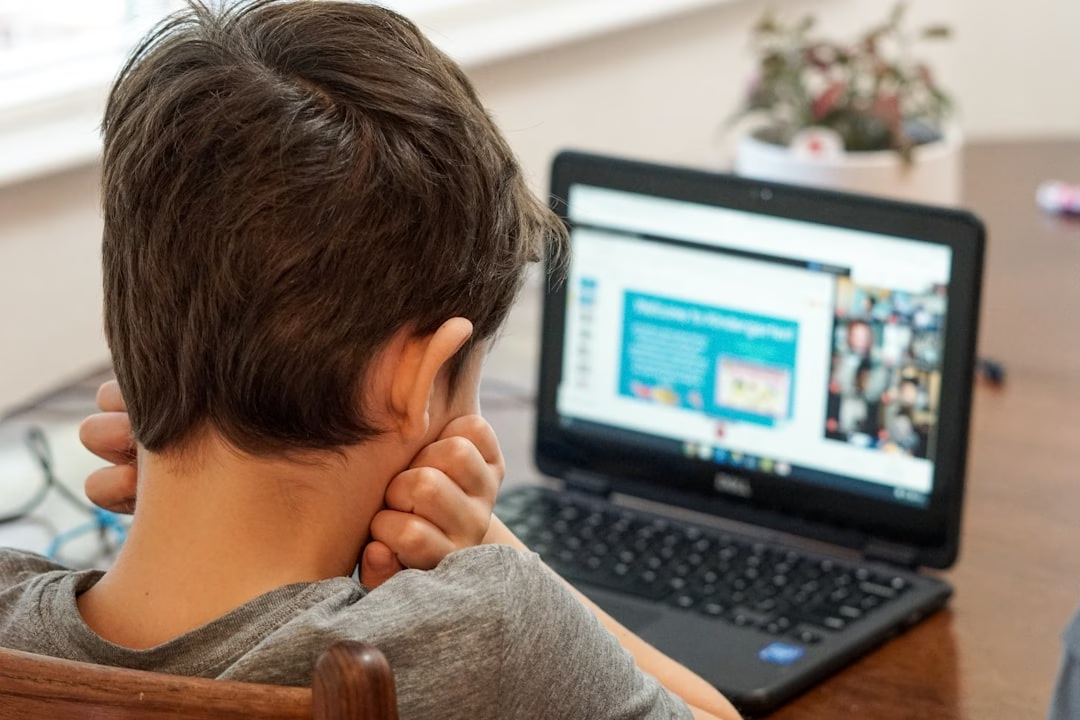

Virtual laboratories access science in ways that traditional brick-and-mortar labs simply cannot match. If you're teaching biology to rural students without a chemistry setup, or running experiments on a budget that went out the window three years ago, these digital platforms are not just nice-to-have — they're reshaping what's actually possible.
The catch? Not every virtual lab is created equal. Some are genuinely interactive. Others are just watching someone else's recorded experiments on a screen (yes, really). Here's what you need to know about how virtual laboratories access science education, what the market actually looks like in 2026, and whether they're worth the investment.
What Virtual Laboratories Access Science Education Actually Means
Virtual laboratories offer students the chance to explore scientific phenomena in safe, controlled environments, and to repeat the experiments as many times as they like, which promotes the comprehension of complex concepts. That's the foundational promise. But there's more depth than just "safe and repeatable."
When you strip it down, virtual laboratories access science through three core mechanisms: virtual labs enable students to conduct science experiments online, which can improve their engagement, critical thinking, and teamwork. You're not just getting a one-way demo. You're handing students the controls.
The real value? Here's the thing. Schools in under-resourced areas can finally run a complete physics curriculum without waiting for someone to buy $50,000 worth of oscilloscopes and power supplies. But honestly — and I need to hedge here — while hands-on experimentation remains a crucial element for mastering concepts, virtual laboratories and other remote learning tools cannot entirely replace in-person lab experiences. The best approach is hybrid. You use virtual labs where they shine and supplement with physical labs when you can.
The Real-World Barriers that Virtual Laboratories Access Science Removes
Let's get specific. I once spent two hours helping a teacher troubleshoot why her students couldn't complete a biology lab. The issue? The school's microscope budget had been cut. They had three working microscopes for 120 students. With a virtual lab platform, all 120 could be doing the work simultaneously.
Equipment costs and safety considerations can make it difficult for teachers to conduct experiments as often as they'd like. Virtual labs remove many of those barriers while strengthening inquiry-based learning with online simulations, digital investigations, and hands-on experiments that allow students to explore scientific ideas in flexible ways, wherever they are.
The barriers virtual laboratories access science by clearing include:
- Cost. No more replacing broken glassware or expired chemicals.
- Safety. You can run experiments with hazardous materials without the liability.
- Scalability. Every student gets a station, not a waiting list.
- Time zones. A student in Bangkok can run the same lab as one in Boston without coordinating schedules.
- Repeat-ability. Mess up an experiment? Run it again. No reagents wasted, no restocking needed.
This matters more than abstract arguments about access. Real schools in real towns are making this work.
Virtual Laboratories Access Science: The Market is Actually Growing Fast
Virtual & Remote Laboratories Market: USD 1.32 billion in 2024 → USD 3.11 billion by 2033, CAGR 10% (Business Research Insights, 2025). That's massive. Virtual Lab Platforms Market: To reach USD 2.98 billion by 2030, CAGR 13.7% (Research and Markets, 2026).
But let's be honest — growth numbers alone don't tell you if a platform is actually good. They just tell you money is flowing. What matters is whether teachers are staying engaged or just abandoning these tools after six months.
Teachers generally hold positive perceptions of the VSLA module across various demographic and professional variables recognizing their potential to enhance students' learning. (That's from a 150-teacher survey conducted in 2026.) Student data backs this up too. Students generally found virtual laboratories to be user-friendly and effective in improving their understanding of difficult science concepts, as well as in developing their ability to follow scientific procedures and engage in inquiry-based learning.
So the adoption is real. Not hype. Real.
Which Platforms are Educators Actually Using?
You don't need me to tell you that throwing $100,000 at Labster might not solve your problems if your LMS is a dinosaur from 2010. Here's what exists right now:
Labster. Labster is a leading virtual lab simulation platform providing over 300 interactive 3D simulations across STEM subjects like biology, chemistry, physics, and engineering. It allows students to perform realistic experiments in a safe, browser-based environment without the need for physical equipment or reagents. It's pricey, but schools that commit to it report higher engagement.
PhET Interactive Simulations. This one's free. PhET Interactive Simulations delivers ready-to-run, research-grade physics and science simulations that behave like virtual lab equipment. The platform supports interactive variables, data collection style tasks, and student-friendly models across chemistry, biology, physics, and math topics. If your budget is zero, start here.
Open edX Virtual Labs. Good if your institution already runs Open edX. Integrates directly into course workflows.
The reality: No single platform dominates. Schools are mixing and matching based on subject, budget, and technical infrastructure. Some use three different platforms across one district.
Virtual Laboratories Access Science Through Better Learning Outcomes ??? or do They?
VLs have been shown to support improvements in conceptual understanding, laboratory skills, scientific literacy, questioning ability, analytical thinking, and cognitive performance, all of which contribute to strengthening critical thinking skills. That's from a 2026 systematic review. Strong signal.
But let me contradict myself slightly. The outcomes depend entirely on how the virtual lab is designed and implemented. The major shift in 2026 is AI integration. Nearly every vendor now claims some form of artificial intelligence, but the implementations vary wildly. Some offer genuine adaptive tutoring that responds to student behaviour in real time. Others simply use AI to generate content or marketing copy.
You've got platforms that scaffold learning beautifully. And you've got others that hand students the answers without letting them struggle. The difference is pedagogical, not technical. A "virtual laboratory access science" platform that's designed poorly — with preset answers and no room for exploration — will underperform a well-designed traditional lab every time.
The Adoption Hurdles (And Why They Matter)
Implementation isn't seamless. The most common challenges include educators unfamiliar with digital lab tools may resist change. I watched this firsthand. A chemistry teacher with 25 years of hands-on experience took one look at a VR lab interface and decided it was "for kids." It took three professional development sessions and peer support before she saw the value. And then? She became an advocate. But not everyone moves that quickly.
The implementation of VLs still faces challenges, particularly in developing practical skills and ensuring integration with physical laboratories. That's the real issue. Virtual labs work best when paired with hands-on experience. Using them alone? You're leaving performance on the table.
Teacher training is non-negotiable. Budget for it.
Frequently Asked Questions
What does Virtual Laboratories Access Science Mean for Remote Students?
Virtual laboratories access science enables remote students to conduct real experiments without being physically present in a classroom lab. They can run simulations, manipulate variables, collect data, and learn inquiry-based science from anywhere with an internet connection. This is especially valuable for homeschooled students, those in rural areas, and learners in developing countries where lab equipment is scarce.
How do Virtual Laboratories Access Science Differently than Watching a Lab Video?
Virtual laboratories access science through interactivity. Students actively manipulate variables, make decisions, and see real-time results. A lab video is passive. You watch someone else do the work. A virtual lab puts you in control. You change the temperature, adjust the reagents, and observe what happens. That agency transforms learning outcomes.
Are Virtual Laboratories Access Science Better than Physical Labs?
Not necessarily. They're different. Physical labs build hands-on skills, spatial reasoning, and tactile memory. Virtual labs offer repeatability, safety, scale, and access. The best approach combines both. Use virtual labs to teach concepts, build intuition, and conduct experiments that are too dangerous or expensive for physical labs. Use physical labs for hands-on skill-building and verification.
Which Virtual Laboratories Access Science Platform is Best for My School?
Depends on your budget, existing tech stack, and subject area. PhET is free and excellent for high school physics and chemistry. Labster is premium, more visual, and better for biology. Open edX integrates with existing LMS platforms. Start with your constraints, not the features.
Can Virtual Laboratories Access Science Work for All Age Groups?
Yes, but implementation matters. Elementary students need more guidance, story-based interfaces, and simpler simulations. Higher ed students can handle more abstract controls and open-ended experiments. Middle school is the sweet spot — old enough to handle complexity, young enough to still be excited by interactive learning.
The Real Takeaway: Virtual Laboratories Access Science, but Only if You Use Them Right
Here's what actually matters: virtual laboratories access science doesn't solve the problem of bad pedagogy. A poorly designed platform with no teacher support and no integration with your curriculum is just an expensive simulation game.
But implemented thoughtfully — paired with good teacher training, woven into an actual course design, and supplemented with physical labs where it makes sense — virtual laboratories access science opens doors that were previously locked by cost, geography, and safety. Rural students get the same chemistry education as those in wealthy suburban districts. A student with a mobility disability can run an experiment without the architectural barriers of a traditional lab. A teacher in Peru can run a physics lesson identical to one in Paris.
That's worth the investment. Start small. Pick one platform. Train your teachers. Measure outcomes. Then expand from there. You don't need to transform everything overnight. You just need to start breaking the barriers one lab at a time.
Medical disclaimer: This article is for general informational purposes and is not medical advice, diagnosis, or treatment. Always consult a qualified physician or healthcare professional for guidance specific to your condition. Do not start, stop, or change any treatment based solely on what you read here.

