
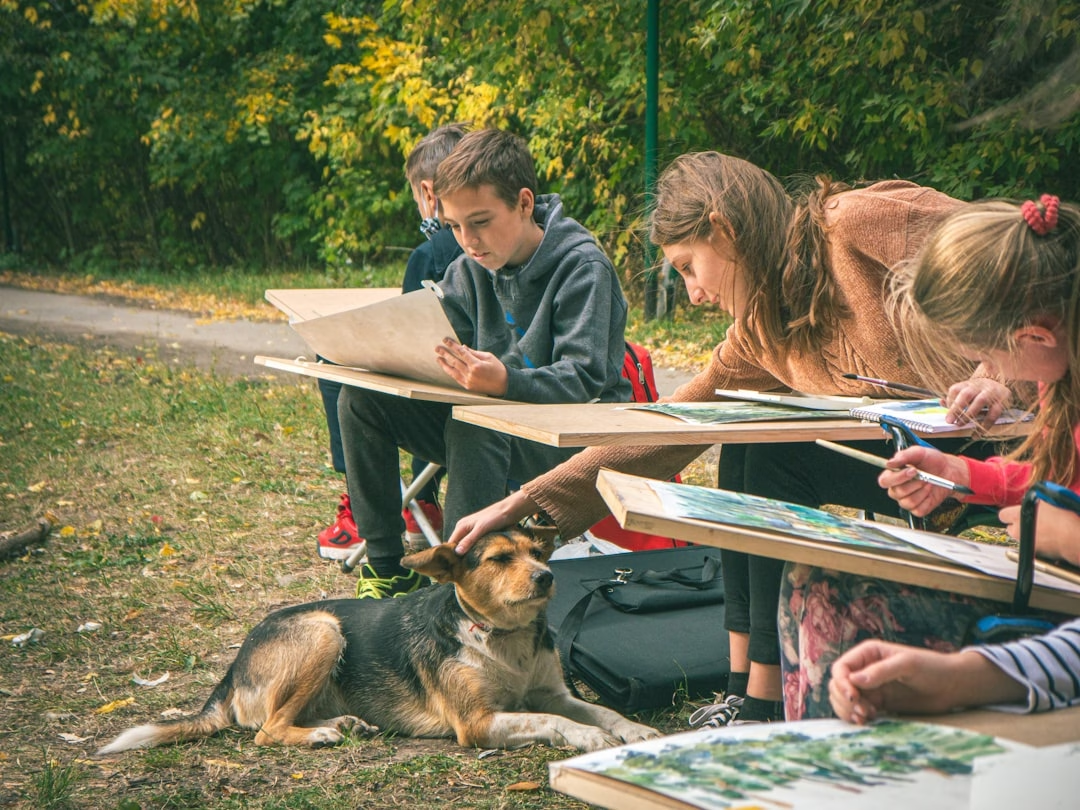

Here's the thing: your kid probably spends six hours a day inside a climate-controlled box with fluorescent lights, sitting in plastic chairs, staring at a whiteboard. Then we wonder why they can't focus. Outdoor learning modern education is making a quiet but powerful comeback—and it's not because nostalgia is trending. The data is too good to ignore.
For the past decade, schools traded outdoor time for test prep and screen time. Recess got shorter. PE budgets shrunk. Play became a four-letter word in education policy. But something shifted in 2026. Teachers, administrators, and (finally) parents started asking a question that should have been obvious all along: what if kids actually learned better outside?
Outdoor learning is associated with improvements in children's literacy, physical health, and social-emotional development, while also benefiting teachers by reducing stress and burnout and enhancing well-being. That's not a small claim. That's the kind of data that should reshape how we think about school design entirely.
This article digs into why outdoor learning modern education is returning, what it actually delivers, and whether your school is ready to make the shift.
Outdoor Learning Modern Education: What's Actually Changing Right Now
The shift isn't abstract. It's happening in real classrooms, in real districts, and it's accelerating. One key shift will be an increased emphasis on outdoor learning, driven by growing awareness of the academic, social-emotional, and physical advantages it offers. In February 2026, education experts predicted this would be one of the dominant trends of the year—and they weren't wrong.
What's different now? Schools aren't just adding a patio and calling it progress. Many schools will move beyond viewing outdoor time as simply recess and instead intentionally extend classroom learning into outdoor settings whenever possible, giving children opportunities to both learn within nature while developing an understanding of it.
Take the 2026 Outdoor Classroom Challenge winners. Readington Middle School, the Grand Prize winner of the 2026 Outdoor Classroom Challenge, is transforming an outdoor fitness area that has gone unused for more than 15 years into a student-designed Tiny Forest | Living Lab. Developed by the school's EcoAmbassadors, the project combines ecological restoration, outdoor learning, student wellness, and accessibility to create an inclusive space where all students can learn and connect with nature.
That's not a field trip. That's curriculum.
The Research Behind Outdoor Learning Modern Education
If you're the type to need numbers before you care, here they are. And they're pretty hard to argue with.
In a systematic review of 147 studies on nature-specific outdoor learning experiences in K-12 educational settings, researchers sought to determine their effects on students' personal and social development, well-being, and academic progress. "Nature-specific outdoor learning has measurable socio-emotional, academic, and well-being benefits and should be incorporated into every child's school experience with reference to their local context," concluded the study authors, reporting in 2022 in the journal Front Public Health.
One hundred and forty-seven studies. Not a small sample size.
When you incorporate nature-based learning into your teaching, pupils demonstrate improved test scores (average 27% higher in some studies). Here's where I'll be honest though: that 27% sounds incredible, almost too incredible. The range of studies is wide—some show dramatic improvements, others modest ones. What consistently appears across studies? Kids retain information better, feel less anxious, and actually show up more engaged. That matters more than perfect testing numbers.

A randomized study of children diagnosed with ADHD found that participants concentrated better after a 20-minute walk in a park than after comparable walks in a downtown area or residential neighborhood. Twenty minutes. That's not an all-day field trip. That's a walk. And yet attention improved measurably.
The stress reduction piece is real too. Time spent in natural environments lowers cortisol, the body's primary stress hormone, in ways that indoor environments simply cannot replicate. If you've ever sat in a classroom fluorescent-lit prison, you know why this matters.
Why Schools Stopped Doing this (And Why that was Dumb)
This is the frustrating part.
Outdoor learning modern education didn't disappear by accident. Schools didn't wake up one morning and think, "You know what would be great? Abandoning the thing that works best." No. It got squeezed out. Slowly. By standardized testing pressures, liability fears, budget cuts, and the seductive promise of educational technology.
Between 2010 and 2020, outdoor education became seen as a luxury. A nice add-on. Something for hippie Waldorf schools or the wealthy. Meanwhile, public schools tightened their belts, eliminated field trips, and shrank recess. Teachers got blamed for lower test scores instead of being asked why they were spending more time on test prep and less time on actual learning.
Then came screens everywhere.
The pandemic accelerated everything. Remote learning taught us that Zoom can't replace real connection. But instead of course-correcting, schools added more tech, more gamified learning platforms, more "digital engagement tools." The irony: kids were more isolated and more distracted than ever.
By 2026, something had to give. Teachers were burnt out. Students were anxious. Attention spans were collapsing. And everyone pretended not to notice that the one thing that actually helped—time outside—was treated like a reward you could take away for misbehavior.
What Outdoor Learning Modern Education Actually Looks Like in Practice
Okay, so you're convinced. But what does this actually look like in a real school?
It's not complicated, which is sort of the point.
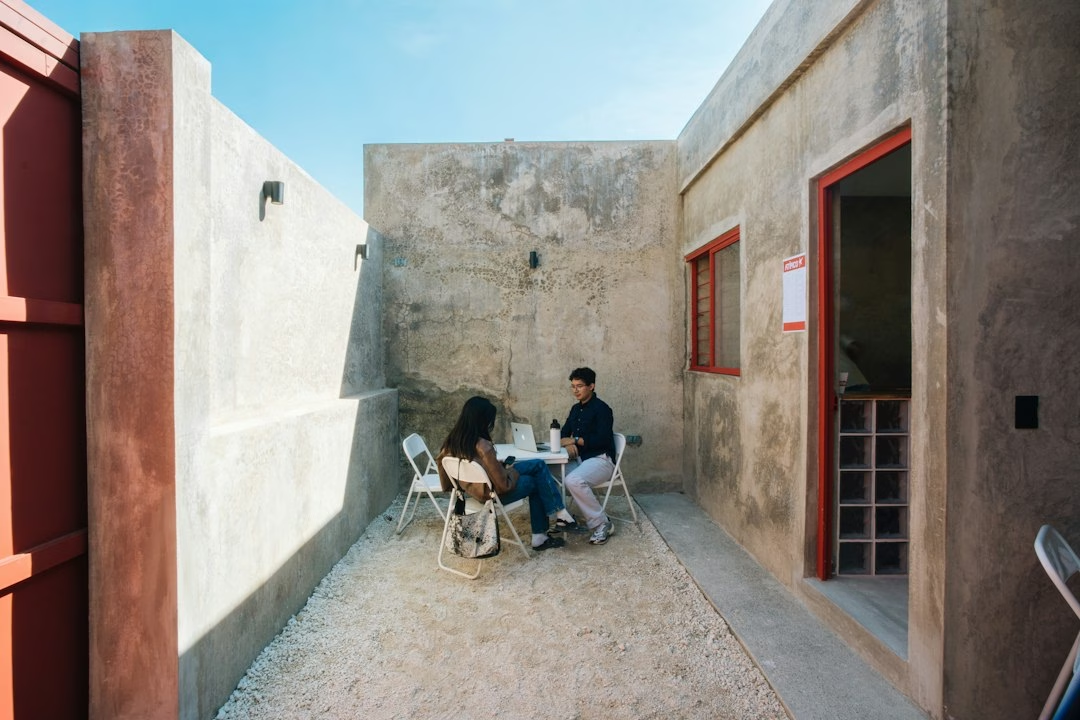
HED's Jefferson Elementary School Outdoor Learning project (part of the San Francisco Unified School District) features outdoor spaces that are both functional and comfortable. Depending on what's being taught in the space, different tools and design elements, such as tables, shade, shelter from the wind or a weather-resistant whiteboard, may be part of the outdoor classroom.
That's the minimum viable outdoor learning setup: shade, weather protection, and a way to write things down. Not some elaborate construction project.
Some schools are building gardens. Some are redesigning playgrounds to include learning stations. Some are literally just moving class outside twice a week. It varies wildly depending on climate, budget, and what teachers are willing to push for. The investment, though, has gotten serious. The global STEAM education market, valued at approximately $1.3 billion in 2021, is projected to reach $3.1 billion by 2026.
Money flows toward what schools believe in. And right now, they're starting to believe in this again.
I once spent an afternoon watching a third-grade math lesson happen under a live oak tree in Austin. No fancy equipment. Just the teacher, five kids, sticks on the ground, and a problem about area and perimeter. One kid—the one who usually checks out during indoor math—was completely locked in. He was literally rearranging sticks to test hypotheses. The teacher wasn't doing anything magical. The environment was doing the heavy lifting.
That's outdoor learning modern education. It's not revolutionary. It's just remembering how humans actually learn.
The Mental Health and Social-Emotional Case
Here's what the research doesn't fully capture in numbers: the mental health crisis in schools.
In 2026, with student mental health at a critical low, attention spans shrinking, and employers increasingly demanding soft skills that classrooms struggle to build, outdoor education is no longer a nice addition to a student's life. It is a necessary one.
Anxiety, depression, and social isolation among students hit record levels in recent years. The solutions offered? More counselors, more therapy, more pharmaceutical interventions. All necessary. But none of them address the root: kids are spending unprecedented amounts of time indoors, under artificial light, in constrained spaces, staring at screens.
According to the Open University's OPENspace Research Centre, time in nature helps to improve mood, reduces symptoms of anxiety and depression, and even helps children focus better at school.
What outdoor learning modern education does, beyond any specific academic metric, is create conditions for resilience. Nature-based learning provides safe challenges, real achievements, and genuine connection with peers, all of which are powerful protective factors for mental health. It is about getting students outside, into real environments, facing real challenges, and learning in ways that actually stick.
That resilience doesn't show up on a standardized test. But every parent would recognize it: a kid who can handle difficulty without falling apart.
The Barriers (And Why They're Easier to Overcome than You Think)
Let's be realistic. Outdoor learning in K-12 schools remains the exception rather than the norm. Why? Same reasons that stop most good ideas: inertia, fear, and logistics.
Liability concerns rank high. What if a kid gets hurt outside? (Statistically, kids get hurt indoors too, more often, and the injuries tend to be worse. But fear isn't rational.)
Weather is another excuse that holds up for about five seconds. Denmark figured this out decades ago. Denmark's concept of 'udeskole' (outdoor school), where students spend regular hours every week learning outside (irrespective of the weather). Denmark is often recognised as a world leader in Outdoor Learning, and its recent national TEACHOUT pilot has provided research evidence of Outdoor Learning benefits to primary school students' physical activity, motivation for school, prosocial behaviour, and even reading performance.
Irrespective of the weather. Including Danish winter. If that works, your September rain isn't a blocker.
Teacher training is a real barrier. Many teachers graduated from teacher-training programs that taught them nothing about outdoor pedagogy. That's changing—slowly—but schools need to invest in professional development. That costs money. Guess what? So does everything. And outdoor learning delivers better ROI than most.
The biggest barrier, honestly, is that outdoor learning modern education doesn't sell textbooks. It doesn't sell software. It doesn't generate licensing revenue. So nobody with major financial stakes is marketing it to districts. Schools have to figure it out on their own or learn from peers who are already doing it.
But here's the encouraging part: many already are.
Frequently Asked Questions
What Exactly is Outdoor Learning Modern Education?
Outdoor learning modern education refers to structured, curriculum-aligned instruction that happens outside traditional classrooms, often in natural environments. It's not just nature study or field trips—it's taking regular subjects (math, literacy, science, history) and delivering them outdoors through direct experience and hands-on activity. It can include forest schools, school gardens, outdoor science labs, or simply moving class outside whenever conditions allow.
Does Outdoor Learning Modern Education Actually Improve Test Scores?
Research shows that outdoor learning modern education correlates with improved academic outcomes, though the mechanisms vary. Children who regularly engage with nature show improved concentration and academic performance. Studies demonstrate that direct experience with nature creates powerful learning moments that traditional classrooms cannot replicate. The boost isn't magical—it comes from deeper engagement, better retention, and reduced cognitive load from typical classroom stressors.
Can Schools on Tight Budgets Implement Outdoor Learning Modern Education?
Absolutely. Outdoor learning modern education doesn't require expensive facilities. A shaded outdoor space, some basic tables, and teacher buy-in are enough to start. Many of the most effective outdoor lessons require minimal equipment—sticks, rocks, plants already on campus. High-quality implementation costs more, but basic implementation can start immediately with existing resources.
How does Outdoor Learning Modern Education Affect Teacher Workload?
Although teachers' lack of confidence to teach outside was initially a challenge, teachers reported positive impacts on their professional practice, health and wellbeing, and job satisfaction. Teachers do need initial training and support, but once they've taught outside, most report enjoying it more than indoor teaching. The outdoor environment handles much of the behavior management and engagement work for you.
What Weather Conditions are Too Extreme for Outdoor Learning Modern Education?
Most conditions are workable if you're prepared. Extreme heat, severe storms, and dangerously low temperatures warrant moving indoors temporarily. But light rain, wind, cold, and typical seasonal variation? Those are learning opportunities, not obstacles. Denmark runs year-round outdoor school in Scandinavian winters as evidence that "too cold" is often an excuse, not a real limit.
The Clear Takeaway: This Isn't a Trend, It's a Correction
Outdoor learning modern education is returning to schools not because it's novel or trendy. It's returning because it was always the better option. We just forgot for a generation—distracted by test scores, budgets, and the seductive promise that more technology would solve everything.
Here's what matters: you have permission to demand this for your kids. Teachers have permission to try it, even if your district doesn't have it formally approved. Schools have permission to redesign outdoor space with learning in mind, not just aesthetics.
The research is there. The examples are multiplying. The barriers are mostly excuses. What's left is the willingness to remember that humans—especially young humans—actually learn better when they're outside, moving, noticing things, and facing real challenges instead of worksheet questions.
Your school may or may not be ready. But the evidence says it should be. And 2026 is the year more of them finally are.
Disclaimer: This article is for general informational purposes and is not financial or investment advice. Markets, products, tax rules, and regulations vary by country and change frequently. Consult a licensed financial advisor, qualified investment professional, or other relevant licensed expert in your jurisdiction before making any investment, lending, insurance, or tax-planning decision.
Medical disclaimer: This article is for general informational purposes and is not medical advice, diagnosis, or treatment. Always consult a qualified physician or healthcare professional for guidance specific to your condition. Do not start, stop, or change any treatment based solely on what you read here.

