


Here's the thing about trade credit supporting cash flow. You probably know it's important. You've heard it mentioned in meetings. But most people don't actually understand how it works, or why a company paying you in 90 days instead of 30 can make the difference between scaling and going under.
Trade credit supports cash when a buyer gets goods now but pays later—creating what accountants call "working capital in motion." According to 2025 figures from The Hackett Group, the 1,000 largest publicly traded nonfinancial U.S. companies still have $1.7 trillion tied up in excess working capital, including $600 billion in accounts receivable alone. That's not a bug. That's the system. And if you're running a business, you're trapped in it too.
This article cuts through the finance-speak and shows you exactly how trade credit supports cash across global supply chains—what actually works, what costs you money, and what you need to do today.
Why Cash Flow is Your Real Problem (Not Revenue)
You can be growing. Growing fast. Revenue up 40%.
And still be broke.
Why? Because of the gap. The gap between when you pay your suppliers and when your customers pay you. That gap is death for small operations and a constant headache for large ones.
Cash flow remained the top challenge for 55% of business owners in 2026, nearly unchanged from 54% the year before. Not debt. Not competition. Cash flow. And trade credit supporting cash is one of the few ways to actually shrink that gap instead of just accepting it.
Here's a real example: You're a manufacturer. You need $50,000 in raw materials to make a widget. You pay the supplier on day 1. Your customer doesn't pay you until day 60. For 60 days, you're sitting with that $50,000 coming out of your pocket. Multiply that by your entire product line, across dozens of suppliers and customers—and suddenly you understand why companies with millions in annual revenue can run out of money on a Tuesday.
Trade credit supporting cash solves this by literally compressing that gap. If you can get your suppliers to extend payment terms from net-30 to net-60, you've bought yourself time. Time is cash. Time is options.
How Trade Credit Supports Cash Across Borders
Global supply chains are where things get complicated.
Think about a clothing importer in Los Angeles buying from a factory in Vietnam. The factory needs payment before goods ship. The shipping takes 30 days. U.S. customs and logistics add another 10 days. The importer doesn't have inventory until day 40, and retail customers don't pay for another 45 days on top of that.
That's 85 days of waiting. And the importer's bank account is emptier on day 1 than day 85.
Trade credit supporting cash in this scenario means using tools like letters of credit, open account terms, or supply chain finance platforms to bridge the gap. Recent metrics show 49% compliance efficiency improvement and 37% cost reduction via letters of credit, with 65,000+ smart contracts executed and 50% growth in trade finance platforms.
You're not borrowing money at interest rates. You're restructuring when the money moves. That's fundamentally different.
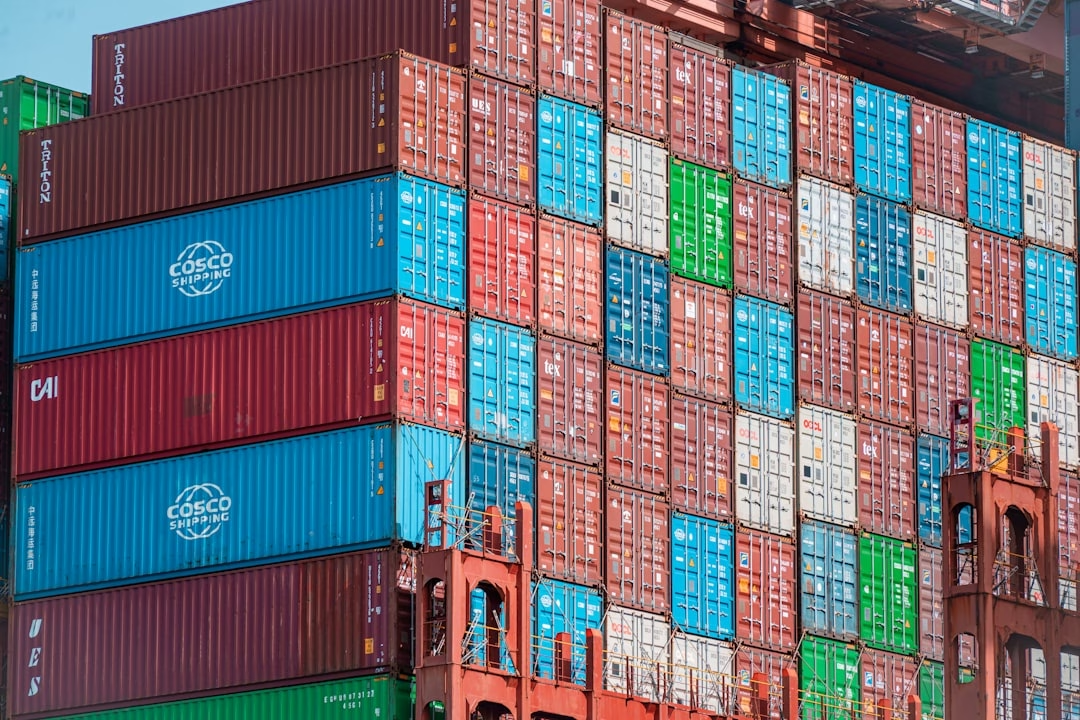
The catch? It only works if both sides trust each other. The factory in Vietnam needs confidence they'll actually get paid. The importer needs confidence the goods won't be seized in customs. That's where intermediaries—export credit agencies, insurance providers, and fintech platforms—step in.
The trade credit insurance market will grow from $13.29 billion in 2025 to $14.55 billion in 2026 at a compound annual growth rate (CAGR) of 9.5%. Those insurers are essentially saying: "I believe this deal is safe. You can extend terms. I'll cover the risk."
Trade Credit Supports Cash Through Supplier Financing Programs
Here's where it gets practical.
Large companies—Amazon, Walmart, Unilever—have figured something out: if they can keep their suppliers alive and happy, they can negotiate better prices and more reliable delivery. So they've built programs where suppliers can get paid early, at a discount.
This is called "dynamic discounting" or "supply chain finance." The supplier is owed $100,000 on day 60. They can choose to get $98,000 on day 10. The buyer's money stays in their account longer, earning returns or funding other operations. The supplier gets immediate cash.
Both sides win. Nobody is bleeding.
According to Citi's 2026 trade report, supplier willingness to borrow increased to 28% in 2025 (up from 19% in 2024). That jump tells you everything: suppliers are desperate for cash certainty. They'll take a 2% discount for guaranteed liquidity. That's not greed—it's survival.
Trade credit supporting cash via these programs has exploded because the alternative is worse. A supplier facing a cash crunch either shuts down (your supply line collapses) or takes expensive short-term debt (they raise prices, you pay more).
Supply chain finance is most effective for businesses with large, recurring supplier bases where payment terms compress cash flow or where supplier financial health is critical to operations. When implemented effectively, SCF improves the entire cash conversion cycle, not just one side of the balance sheet.
The Deep-Tier Problem: When Cash Doesn't Flow Down
Here's the part nobody talks about at industry conferences.
Trade credit supporting cash works great—if you're big enough to get on a major buyer's radar. If you're Tier 2 or Tier 3 (a supplier's supplier), good luck.
I once spent three weeks trying to get a small Vietnamese wire supplier financed through a multinational electronics company's SCF program. The electronics company was creditworthy, the supply chain was solid, the wire supplier was solvent. But because the wire supplier wasn't a "direct" supplier to the big buyer, they fell through the cracks.
Technology is starting to fix this.
In 2026, Deep-Tier Supply Chain Finance (DTSCF) is finally moving from concept to reality. Technology now allows creditworthiness to flow down the chain. A Tier 2 supplier can get paid early based on the strong credit rating of the anchor buyer (Tier 1's customer), even if they have no direct contract with them.
This matters because risk often hides in Tier 2 and Tier 3 (the suppliers of your suppliers), where SMEs struggle to access affordable cash. If your second-tier supplier fails, your entire line stops. But they've been invisible to financing for years.
Trade credit supporting cash at every level of the chain—not just the top tier—is becoming a competitive necessity. Companies building these networks first will own their supply chains. Others will keep getting surprised.
Managing Working Capital When Tariffs Crush Your Timeline
This is live. This is happening right now in 2026.
73% of business owners say tariffs and trade policy changes have affected their operations, with 66% reporting higher supply costs and 46% reporting margin compression. For businesses that rely on imported inputs or components, tariff-driven cost increases function as a working capital tax: the business must pay more upfront for the same inventory while selling prices adjust more slowly.
What does that mean? Your cost of goods just increased. Your customer hasn't agreed to pay more yet. Your working capital problem got worse overnight.
This is where trade credit supporting cash becomes literally a survival tool. If you can negotiate extended payment terms with your suppliers (or use a supply chain finance platform to accelerate receivables from customers), you buy time to pass price increases down the line.
Businesses that order earlier to avoid tariff uncertainty, or that must carry larger buffer stock to manage supply chain volatility, are tying up more working capital in inventory for longer periods. The cash commitment extends; the revenue from that inventory does not arrive any faster.
You're caught between two forces: suppliers demanding faster payment to cover their own cost increases, and customers refusing to pay more. The space between them is where you're standing.

The only way through is intelligent payment restructuring. Not moving money around faster. Moving it in smarter patterns.
Frequently Asked Questions
What is Trade Credit and How does Trade Credit Support Cash?
Trade credit is when a supplier delivers goods or services now and the buyer pays later (typically 30–90 days). Trade credit supports cash by deferring payment obligations, freeing up money for other operations, reducing the need for external financing, and extending the company's cash conversion cycle. In effect, you're using the supplier's money to fund your business short-term.
How does Trade Credit Support Cash Flow in International Supply Chains?
In global supply chains, trade credit supporting cash typically involves extending payment terms across borders (Net-60 or Net-90), using letters of credit to reduce payment risk, and leveraging supply chain finance platforms. These tools compress the gap between when goods ship and when payment is due, allowing companies to manage multi-week transit times and customs delays without depleting working capital.
Can Small Suppliers Access Trade Credit Supports Cash Programs?
Yes, but it's harder. Small suppliers (Tier 2 and Tier 3) historically couldn't access supply chain finance programs. In 2026, deep-tier supply chain finance (DTSCF) platforms are changing this by allowing smaller suppliers to access early payment based on their buyer's creditworthiness, even without a direct contract with large anchor buyers.
Why is Trade Credit Supporting Cash More Important in 2026 than Before?
Trade policy uncertainty, tariff increases, and supply chain disruptions have compressed margins and extended payment timelines. Cash flow is the top challenge for 55% of small business owners in 2026, and 80% of business owners experienced inflation-related cost increases, adding persistent pressure to working capital planning. Trade credit supporting cash is now less of an optimization and more of a necessity for survival.
What's the Difference Between Trade Credit and Supply Chain Finance?
Trade credit is the standard payment term between buyer and seller (e.g., Net-30). Supply chain finance is the broader toolkit—dynamic discounting, early payment platforms, and lender-intermediated programs—that allows companies to restructure those terms and access liquidity before invoices are due.
The Bottom Line: You Need this
Here's the reality: the global logistics market reached $11.23 trillion in 2025, and every single dollar moving through that system needs to be financed somehow.
Trade credit supporting cash isn't exotic. It's not a hack or a loophole. It's the basic infrastructure that keeps global trade moving. Your suppliers use it. Your customers use it. Your competitors are getting better at it.
If you're not actively managing your payment terms, restructuring receivables, or using supply chain finance platforms, you're leaving money on the table—not as an opportunity cost, but as actual cash you're not able to access when you need it.
The companies winning in 2026 aren't the ones with the cheapest costs. The suppliers winning in 2026 are the ones with the most control. By using early payment platforms to accelerate receivables, you aren't taking on risky long-term debt. You are simply ensuring that when the market moves, you have the cash on hand to move with it.
Start with your biggest suppliers and customers. Map out your cash conversion cycle. Look for 20–30-day gaps where trade credit supporting cash can free up liquidity. Then build from there. That's not a strategy. That's survival.

