
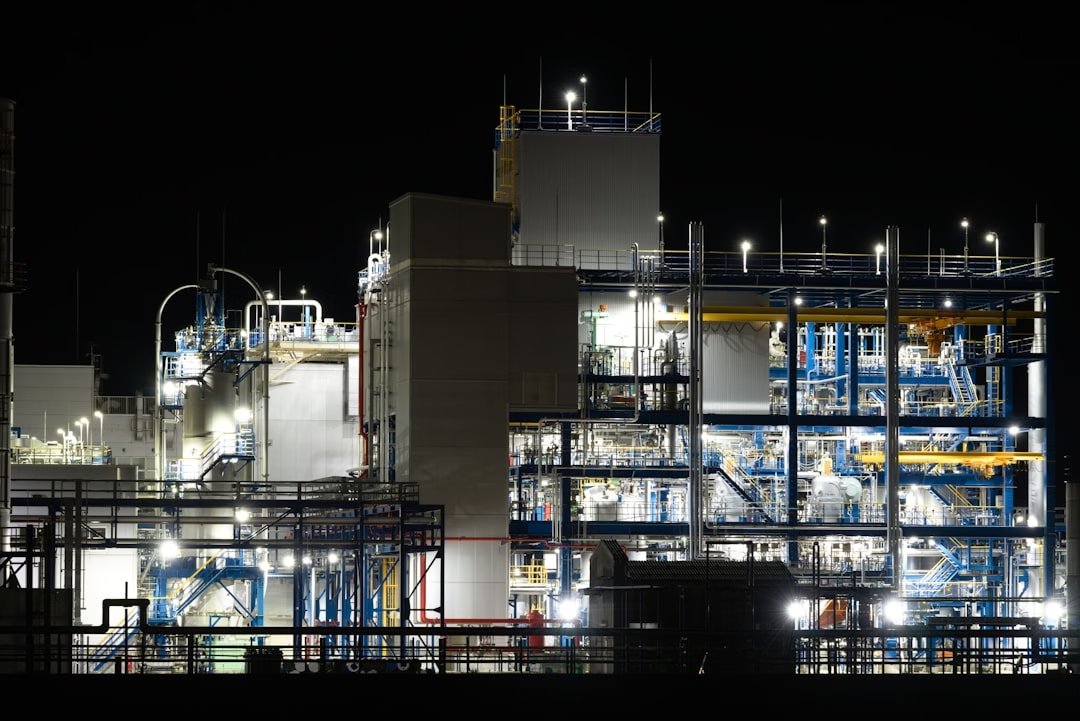

Here's the thing about carbon capture technology—it's no longer some distant climate fantasy. The rise carbon capture technology is already applied in industrial hydrogen and ammonia production and is a recognized way to reduce CO2 emissions from syngas-based processes. But this isn't evenly distributed progress. The technology exists. The infrastructure exists. What's missing is scale and the sheer willingness to fund it at the necessary level. And honestly, that's finally starting to shift.
I spent three years watching carbon capture stuck in the "promising pilot stage" phase—all press releases, no real deployment. Then something changed around 2024-2025. Suddenly, actual money started flowing. In March 2026, the IEA stated that more than US$15 billion in commercial debt had been raised for CCUS projects during the previous two years. That's not venture capital betting on future promise—that's institutional investors backing real projects. The rise carbon capture technology is happening because, finally, the economics started to make sense.
Understanding the Rise Carbon Capture Technology: What You're Actually Looking at
The rise carbon capture technology encompasses three main technical approaches, and they're not interchangeable. The most widely deployed capture systems today rely on post-combustion chemical absorption, typically using amine-based solvents. That's the workhorse technology—already proven, already deployed in refineries and hydrogen plants worldwide.
But here's the catch: these technologies are commercially proven and remain the default option for retrofitting existing industrial assets, though they are energy-intensive and contribute significantly to operating costs. Energy-intensive means you're using tons of energy to capture the CO2 you're trying to prevent. It's not a bad tradeoff necessarily, but it's not elegant.
The alternative approaches—pre-combustion and direct air capture (DAC)—are fundamentally different beasts. Point-source carbon capture removes CO₂ from an industrial exhaust stream before it reaches the atmosphere, while direct air capture, commonly called DAC, removes carbon dioxide that has already mixed with the surrounding air. DAC sounds like magic. It's basically a giant filter for the entire atmosphere. Except it's not magic. It's expensive and early-stage.
The Rise Carbon Capture Technology Across Different Industries
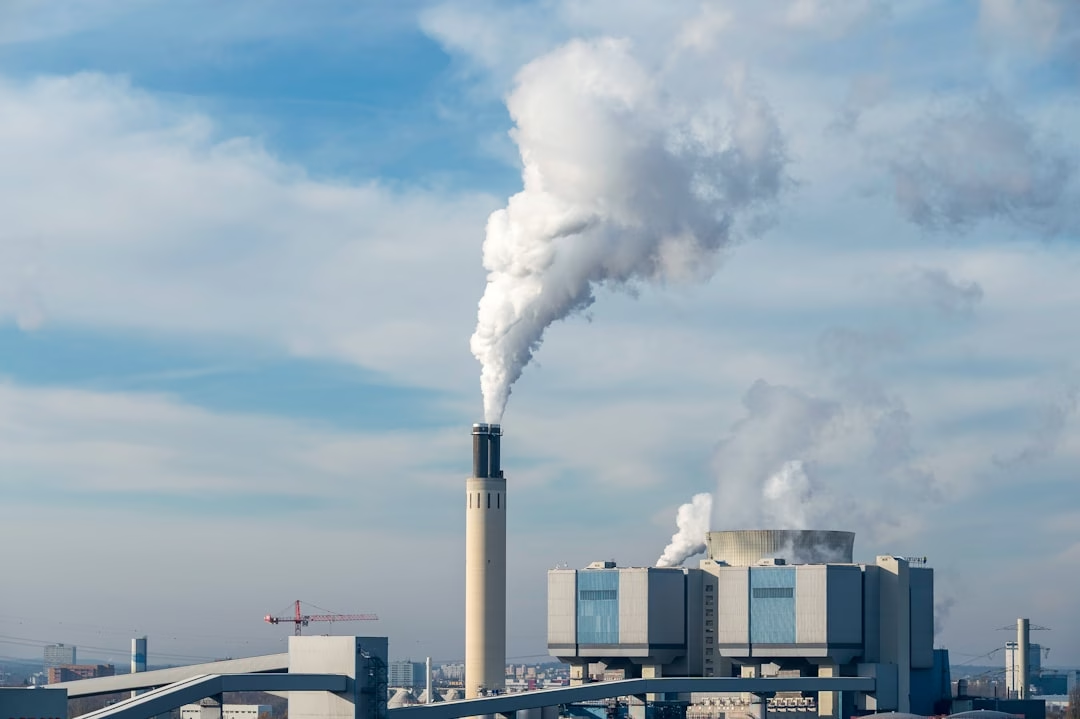
You can't just bolt the same capture system onto a cement plant that you'd use at a power station. The industrial applications vary wildly, and for cement plants, power facilities and other large industrial exhaust streams, companies such as Mitsubishi Heavy Industries and SLB Capturi offer suitable solutions.
Here's where the rise carbon capture technology actually matters economically. The IEA estimates that ~230 Mt of CO2 are currently used each year globally, largely for urea manufacturing (~130 Mt) and enhanced oil recovery (~80 Mt). That's not a weakness—it's the entire business model. You're not just storing CO2; you're selling it. Enhanced oil recovery is controversial (yes, I know), but it's currently funding the technology's expansion. What you do with that CO2 after capture determines whether this is actually decarbonization or just a displacement strategy.
For modular point-source capture at industrial sites with limited available space, Carbon Clean and Svante offer different equipment approaches, while for large-scale atmospheric carbon removal, 1PointFive, Climeworks and Heirloom Carbon are developing direct air capture projects, and for carbon utilization, LanzaTech converts carbon-rich gases into fuels and chemicals, while CarbonCure mineralizes captured CO₂ inside concrete. The utility companies, the chemical manufacturers, the concrete producers—they're all moving into this space simultaneously.
Market Momentum: Why the Rise Carbon Capture Technology is Accelerating in 2026
Numbers don't lie. The carbon capture, utilization, and storage market will grow from $3.08 billion in 2025 to $3.51 billion in 2026 at a compound annual growth rate of 14.0%. That's consistent growth, not explosive. But consistency matters more than explosiveness at this stage.
More relevant to actual deployment: based on projects announced or under development in early 2025, worldwide CO₂ capture capacity could increase to approximately 430 million tonnes per year by 2030. That's the number that changed my mind about this sector. Four-thirty million tonnes is real infrastructure. That's not theoretical.
Looking toward 2026, technology developers are increasingly focused on incremental efficiency improvements, including advanced solvent formulations with lower regeneration energy requirements, process integration to reduce parasitic energy loads, and modular capture units designed to shorten construction timelines and reduce upfront capital expenditure. Translation: they're making the systems cheaper to run and faster to build. That's how you scale something.

Policy and the Real Cost Driver
Here's what actually matters: incentives. In key markets, provisions such as tax credits (e.g., the US 45Q incentive) offer substantial rewards per ton of CO2 captured and stored or used, with enhanced allocations for emerging technologies like Direct Air Capture (DAC), and such policy incentives have been estimated to exceed $30 billion in total support.
That's the real story. Without the US 45Q tax credit, half of the projects being announced wouldn't pencil out. The rise carbon capture technology isn't driven by environmental virtue—it's driven by policy. Yes, there are companies with genuine climate commitments. But the deployment curve? That's policy-dependent.
In Europe, regulatory frameworks like the EU Industrial Carbon Management Strategy and related clean-industry initiatives aim to harmonize CO2 market structures and facilitate cross-border transport and storage. Europe is building the infrastructure simultaneously. They're not waiting for someone else to move first.
The Patent Landscape: Where Innovation is Actually Happening
Here's a signal that's often missed. Carbon capture and utilization materials innovation is accelerating: the core CCU materials domain now contains 3,001 active patents, with 655 applications filed in 2024 alone—a rate that underscores sustained commercial interest. Three thousand active patents in a niche industrial sector. That's not early-stage. That's competitive.
Amine-functionalized solid sorbents represent the dominant route, with the dispersed particle separation category—covering sorbent and membrane technologies—accounting for 2,243 patents, making it the largest technology classification in the CCU materials landscape. The innovation is flowing toward solid sorbents, not just liquid-phase chemistry. That's important because it suggests the next generation of capture systems will be different—potentially more modular, potentially cheaper.
Frequently Asked Questions
What Exactly is the Rise Carbon Capture Technology in Practical Terms?
The rise carbon capture technology refers to the deployment of industrial systems that remove CO2 from emission sources (power plants, cement facilities, hydrogen production) or directly from air, then either store it permanently underground or use it in products like concrete or chemicals. It's operational now—not a future technology.
How does the Rise Carbon Capture Technology Make Economic Sense?
Currently, the economics work because governments offer substantial tax credits per ton captured (the US 45Q credit, for example), and because captured CO2 has existing uses in enhanced oil recovery and chemical production. As costs decline, these systems may become profitable without subsidies, though that timeline remains uncertain.
What's the Difference Between the Rise Carbon Capture Technology at Power Plants Versus Direct Air Capture?
Point-source capture at industrial facilities is cheaper and more established—it targets concentrated CO2 streams before they enter the atmosphere. Direct air capture (DAC) extracts CO2 that's already dispersed in ambient air, making it far more energy-intensive and expensive per ton, though it works anywhere.
Is the Rise Carbon Capture Technology Actually Helping the Climate?
Honestly? It depends on where the captured CO2 goes. If it's used in products or stored permanently, yes. If it's used in oil extraction to produce more fossil fuels, that's a different story—you've just shifted the emission elsewhere. The rise carbon capture technology is a tool; the intent behind it matters.
What Should I Expect from the Rise Carbon Capture Technology by 2030?
Based on projects announced or under development in early 2025, worldwide CO₂ capture capacity could increase to approximately 430 million tonnes per year by 2030. That's nine times current capacity. Mostly point-source industrial capture. Direct air capture will still be a fraction of total deployment. Expect real infrastructure, not full-scale atmospheric remediation.
The Real Takeaway
The rise carbon capture technology isn't happening because someone solved climate change. It's happening because the financial plumbing finally connected—tax credits meet industrial decarbonization targets meet investor risk appetite. That's less heroic than "we invented our way out," but it's more realistic.
What actually matters: You're no longer betting on this technology's existence. You're betting on deployment speed and cost curves. If you work in cement, chemicals, hydrogen, or power generation, carbon capture isn't hypothetical anymore—it's a capital planning decision. If you're an investor, the question shifted from "will this work?" to "which teams will scale this fastest?" And if you care about emissions, the rise carbon capture technology is one tool among several. It's not the solution. But it's real, it's funded, and it's already running in factories across North America. That's further than it was two years ago.

